
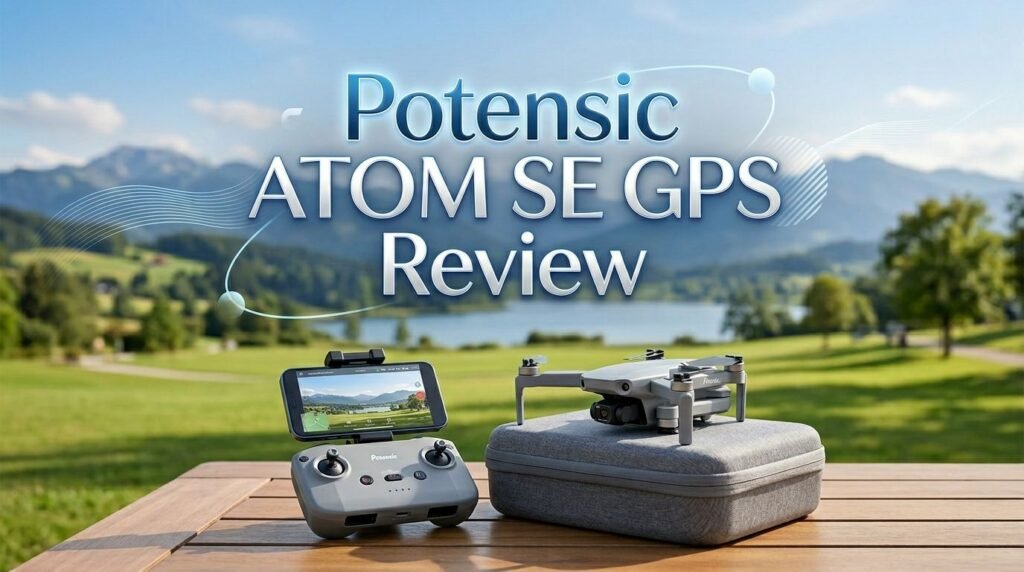
Potensic ATOM SE GPS Drone Review 2026: Worth Buying?
The drone market is flooded with options. You want 4K video. You want GPS. You want something light enough to skip registration headaches. And you don’t want to empty your bank account.
The Potensic ATOM SE GPS Drone checks all of those boxes. But does it actually deliver on its promises in 2026?
I spent hours researching this little drone, digging into real user feedback, specs, and flight performance data. Whether you’re a first-time flyer or a content creator on a budget, this review will give you every detail you need.
Key Takeaways:
- The Potensic ATOM SE weighs under 249 grams, which means you won’t need FAA registration for recreational use in the United States. This is a huge advantage for casual flyers who want to get airborne without paperwork.
- It shoots 4K video at 30fps using a Sony 12MP CMOS sensor. The built-in Electronic Image Stabilization (EIS) helps smooth out shaky footage. You can also capture 12MP still photos in both JPG and RAW (DNG) formats.
- Flight time is impressive at up to 31 minutes per battery. The combo pack includes two batteries, giving you a total of about 62 minutes of air time. That’s generous for a drone in this price range.
- GPS auto return works reliably. If the signal drops or the battery gets low, the drone flies itself back to the takeoff point. This gives beginners real peace of mind.
- The 4KM FPV transmission range lets you fly far while still watching a live feed on your phone. The brushless motor pushes the drone up to 16 meters per second in Sport mode.
- The foldable design makes it extremely portable. It folds down to just 3.46 x 5.63 x 2.28 inches. You can carry it in a jacket pocket or a small bag without any hassle.

Potensic ATOM SE GPS Drone: Design and Build Quality
The Potensic ATOM SE looks and feels more expensive than it is. The body uses a mix of quality plastics and lightweight composites that keep the total weight at just 245 grams (with battery and microSD card). This puts it safely under the 249-gram threshold for registration-free flying.
The foldable arm design is solid. Each arm clicks into place with a satisfying snap. You won’t feel like the arms are going to wobble or break mid-flight. The hinge mechanism has held up well according to long-term user feedback.
The drone’s compact folded size of 3.46 x 5.63 x 2.28 inches makes it easy to toss in a backpack. Unfolded, it measures 11.8 x 9 inches, which gives it a stable flight profile. The propellers are quiet compared to many budget drones, thanks to the brushless motor design.
On the bottom, you’ll find an optical flow sensor and a TOF module. These sensors help the drone maintain stable hover positions, especially indoors or at low altitudes where GPS signal might be weak. The overall build quality punches well above its price point.
4K Camera Performance and Image Quality
The camera on the Potensic ATOM SE uses a 1/3-inch Sony CMOS sensor. It captures 4K video at 30 frames per second and 12MP still photos. For a budget drone, the image quality is genuinely impressive.
The ShakeVanish EIS technology does a solid job of smoothing out vibrations and minor movements. Your footage won’t look like it was filmed during an earthquake. However, EIS is not the same as a mechanical gimbal. You’ll notice some minor jello effects in windy conditions or during fast turns.
The lens offers a 118-degree field of view with a tilt range from +20 degrees to -90 degrees. This wide angle captures sweeping landscape shots with ease. You can adjust the camera angle remotely through the app during flight.
One standout feature is the ability to shoot RAW (DNG) photos. This gives photographers more flexibility in post-processing. You can recover shadows, adjust white balance, and push colors further than JPG files allow. For a drone at this price, RAW support is a welcome bonus.
Colors appear natural and well-balanced in daylight. Low-light performance is limited, as expected from a smaller sensor. Stick to golden hour or bright conditions for the best results.
Flight Time and Battery Life
Battery life is one of the strongest selling points of the Potensic ATOM SE. A single battery delivers up to 31 minutes of flight time. The combo package ships with two batteries, giving you a combined total of approximately 62 minutes in the air.
In real-world testing, most users report about 25 to 28 minutes per battery. Wind, speed mode, and camera usage all affect how long the battery lasts. That’s still excellent for this price category.
The batteries are lightweight and easy to swap. They slide into the rear of the drone and lock with a simple click. Charging a single battery takes about 60 to 90 minutes with the included charger. If you purchase the fly more combo with the 60W fast parallel charging hub, you can charge all batteries at once, which saves a lot of time.
Battery management through the app is clear and helpful. You can see the remaining charge percentage in real time on your screen. The drone will also trigger an automatic return-to-home function when the battery drops to a critical level. This prevents the drone from falling out of the sky.
GPS and Smart Flight Modes
The Potensic ATOM SE uses a dual GPS and GLONASS satellite system for accurate positioning. This means the drone locks onto its location quickly and holds its position with precision, even in moderate wind.
The auto return-to-home feature is one of the most important GPS functions. Press the button, and the drone flies back to its launch point on its own. It also activates automatically if the remote loses connection or the battery runs low.
Smart flight modes add creative options to your flights. Waypoint mode lets you draw a flight path on the app map. The drone then follows that path automatically while you control the camera. Orbit mode makes the drone circle a fixed point, which is perfect for dramatic reveal shots.
Follow Me mode is available and tracks your movement using GPS data from your phone. Keep in mind this is phone-based tracking, not visual tracking. It works best in open areas without obstacles.
The drone also supports one-key takeoff and landing, which simplifies the process for beginners. You press a button, and the drone lifts off to a preset hover height. Landing is just as easy.
Top 3 Alternatives for Potensic ATOM SE GPS Drone


Remote Controller and Range
The Potensic ATOM SE comes with a dedicated remote controller that holds your smartphone. The controller layout is clean and intuitive. You get two joysticks, a return-to-home button, a power button, and a camera shutter/record toggle.
Your phone clips into the top of the controller. The connection between the controller and your phone happens through a USB cable. This wired link is more stable than a Bluetooth connection and reduces video lag.
The maximum transmission range is 4 kilometers (about 2.5 miles). In practice, you’ll get clean video feeds up to about 2 to 3 kilometers depending on your environment. Buildings, trees, and electromagnetic interference can reduce the effective range.
The controller feels comfortable in hand. It’s not too bulky, and the joysticks respond smoothly. Battery life on the remote is excellent. It will outlast several drone batteries on a single charge. The controller also features detachable joysticks for easy storage.
Potensic Fly App Experience
The Potensic ATOM SE pairs with the Potensic Fly app, available on both iOS and Android. The app serves as your flight dashboard, camera viewfinder, and settings menu all in one place.
Setup is straightforward. You download the app, create an account, connect the drone, and follow the on-screen calibration steps. First-time users can be flying within 10 to 15 minutes of unboxing.
The live camera feed appears on your phone screen with telemetry data overlaid. You can see altitude, distance, speed, battery level, and satellite count at a glance. The map view shows your drone’s position relative to the home point.
Flight modes and camera settings are accessible through clear on-screen icons. You can switch between Video, Normal, and Sport modes with a tap. Camera exposure, white balance, and resolution settings are easy to adjust.
The app also stores your flight logs and records. You can review past flights, check distances covered, and see routes flown. Some users have reported occasional lag in the video feed, but this is common with budget drones and usually resolves by adjusting your phone’s display settings.
Wind Resistance and Stability
For a sub-250-gram drone, the Potensic ATOM SE handles wind better than you might expect. It can operate in winds up to Level 5 on the Beaufort scale, which means light to moderate breezes of roughly 19 to 24 mph.
The GPS lock and optical flow sensors work together to keep the drone steady during hover. Even in gusty conditions, the ATOM SE holds its position without drifting excessively. The brushless motors provide consistent power output, which helps maintain stability.
In Sport mode, the drone reaches a top speed of 16 meters per second (about 36 mph). This speed helps it push through headwinds more effectively. If you’re flying in breezy conditions, Sport mode is your best bet for stable returns.
That said, flying in strong wind will drain your battery faster. The motors work harder to maintain position, which cuts into your total flight time. On very windy days, expect to lose 5 to 8 minutes from your normal flight duration.
The EIS system also compensates for some wind-induced vibrations in your footage. Your video won’t be perfectly smooth in heavy gusts, but it will be watchable and usable for most purposes.
Who Should Buy the Potensic ATOM SE?
The Potensic ATOM SE is built for a specific audience, and it serves that audience very well. Beginners will love the easy setup, GPS safety features, and forgiving flight controls. The auto return-to-home function alone removes a lot of the anxiety that comes with flying a drone for the first time.
Travel enthusiasts and content creators on a budget will appreciate the compact size and 4K camera. The drone fits in a small bag, weighs almost nothing, and produces footage that looks great on social media. It’s a perfect companion for hiking, road trips, and vacations.
Hobbyists who want to practice aerial photography without investing in a $500+ DJI drone will find the ATOM SE a smart entry point. The RAW photo support is a nice touch for anyone who likes to edit their images.
This drone is not ideal for professional videographers who need a mechanical gimbal, obstacle avoidance, or 4K/60fps recording. It’s also not the best choice for flying in heavy rain or extreme conditions. But for casual use and budget-conscious buyers, it delivers outstanding value.
Potensic ATOM SE vs. DJI Mini 4K
This is the comparison most buyers want to see. Both drones weigh under 249 grams. Both shoot 4K video. Both have GPS. But there are key differences.
The DJI Mini 4K has a 3-axis mechanical gimbal. This gives it noticeably smoother video than the ATOM SE’s electronic stabilization. If video quality is your top priority, the DJI wins this round.
The Potensic ATOM SE offers longer flight time. With 31 minutes per battery versus the DJI’s similar per-battery time, both are close. But the ATOM SE combo pack with two batteries and a parallel charger gives it a practical edge.
Price is where the ATOM SE shines. It costs significantly less than the DJI Mini 4K, especially in combo form. You get two batteries, a carrying case, and extra propellers at a price lower than the DJI’s single-battery kit.
The DJI ecosystem is more polished. The DJI Fly app is smoother, and DJI’s customer support network is larger. But the Potensic Fly app has improved a lot and handles all the essential functions well.
For beginners on a budget, the ATOM SE is the smarter buy. For those who value gimbal-stabilized video and brand reliability, the DJI Mini 4K justifies its higher price.
Pros and Cons of the Potensic ATOM SE
Every product has strengths and weaknesses. Here’s an honest breakdown of what works and what doesn’t on the Potensic ATOM SE.
The 4K camera with Sony sensor produces sharp, colorful footage in good lighting. RAW photo support is a bonus you rarely see at this price. The 118-degree wide-angle lens captures expansive landscapes with a single frame.
Flight time is excellent. Two batteries give you over an hour of total air time. The GPS auto return feature works reliably and adds a real safety net. The foldable design is compact and travel-friendly. The drone fits in spaces where larger competitors simply can’t.
On the downside, the electronic stabilization has limits. Fast movements and strong wind will produce shaky footage. A mechanical gimbal would solve this, but that adds cost and weight. Low-light camera performance is weak. The small sensor struggles in dim conditions.
There is no obstacle avoidance system. You must fly carefully around trees, buildings, and other objects. The app can be laggy at times, though updates have improved performance. Finally, the follow-me mode relies on phone GPS, which is less precise than visual tracking.
Is the Potensic ATOM SE Worth It in 2026?
Yes, the Potensic ATOM SE remains one of the best budget GPS drones you can buy in 2026. The combination of 4K video, sub-249g weight, GPS features, and long battery life at this price point is hard to beat.
The drone market has expanded since the ATOM SE first launched. New competitors have entered the scene. But few of them match the ATOM SE’s balance of features, portability, and affordability. It continues to rank among the top-selling budget drones on Amazon for good reason.
Potensic has also continued to update the firmware and app over time. These updates have improved flight stability, camera performance, and overall user experience. Buying the ATOM SE today means you get a more refined product than what early adopters received.
If you need professional-grade footage, look at the DJI Mini 4 Pro or higher-end options. But if you want a fun, reliable, and capable drone that won’t break the bank, the Potensic ATOM SE GPS Drone is an excellent choice in 2026.
How to Get the Best Footage from Your Potensic ATOM SE
Getting great aerial footage starts with good flight habits. Always calibrate your compass before flying in a new location. This ensures the GPS and flight controls work accurately.
Fly during golden hour (the hour after sunrise or before sunset). The warm, soft light produces the most cinematic footage. The Sony sensor on the ATOM SE handles these lighting conditions beautifully.
Use Normal mode for smooth, cinematic shots. Sport mode is great for speed, but the faster movements create shakier footage. Slow, deliberate stick movements produce the best results with EIS.
Set your camera to 4K/30fps for the highest quality video. If you’re shooting photos, switch to RAW format. This gives you the most editing flexibility in apps like Lightroom or Snapseed.
Plan your shots before you fly. Think about the composition, the direction of the sun, and any obstacles in the area. Waypoint mode is perfect for repeatable, smooth flight paths. Set your route, start recording, and let the drone do the flying while you focus on framing.
Keep your microSD card fast and reliable. A Class 10 or UHS-I card with at least 64GB of storage is recommended. Slow cards can cause dropped frames or recording errors.
Frequently Asked Questions
Does the Potensic ATOM SE require FAA registration?
No. The Potensic ATOM SE weighs under 249 grams, which means it does not require FAA registration for recreational use in the United States. However, you still need to follow local drone flying laws and take the TRUST recreational safety test.
Can the Potensic ATOM SE fly indoors?
Yes. The optical flow sensor and TOF module on the bottom of the drone allow it to maintain stable hover indoors where GPS signal is unavailable. Fly carefully and in a large, open indoor space to avoid collisions since there is no obstacle avoidance.
What microSD card does the Potensic ATOM SE need?
The drone supports microSD cards up to 256GB. A Class 10 or UHS-I card is recommended for smooth 4K video recording. The card is not included in the box, so you’ll need to purchase one separately.
How far can the Potensic ATOM SE fly?
The maximum transmission range is 4 kilometers (about 2.5 miles). Real-world range depends on your environment. Open fields give you the best range. Urban areas with buildings and interference will reduce it.
Does the Potensic ATOM SE have obstacle avoidance?
No. The Potensic ATOM SE does not have any obstacle avoidance sensors. You must fly with clear line of sight and avoid obstacles manually. This is one trade-off for keeping the price and weight low.
Is the Potensic ATOM SE waterproof?
No. The drone is not waterproof or water-resistant. Do not fly it in rain, snow, or heavy fog. Moisture can damage the electronics and motors. Always check weather conditions before flying.
How long does it take to charge the battery?
A single battery charges in approximately 60 to 90 minutes using the standard charger. The 60W fast parallel charging hub, available in the fly more combo, charges multiple batteries at the same time and reduces total charging time.