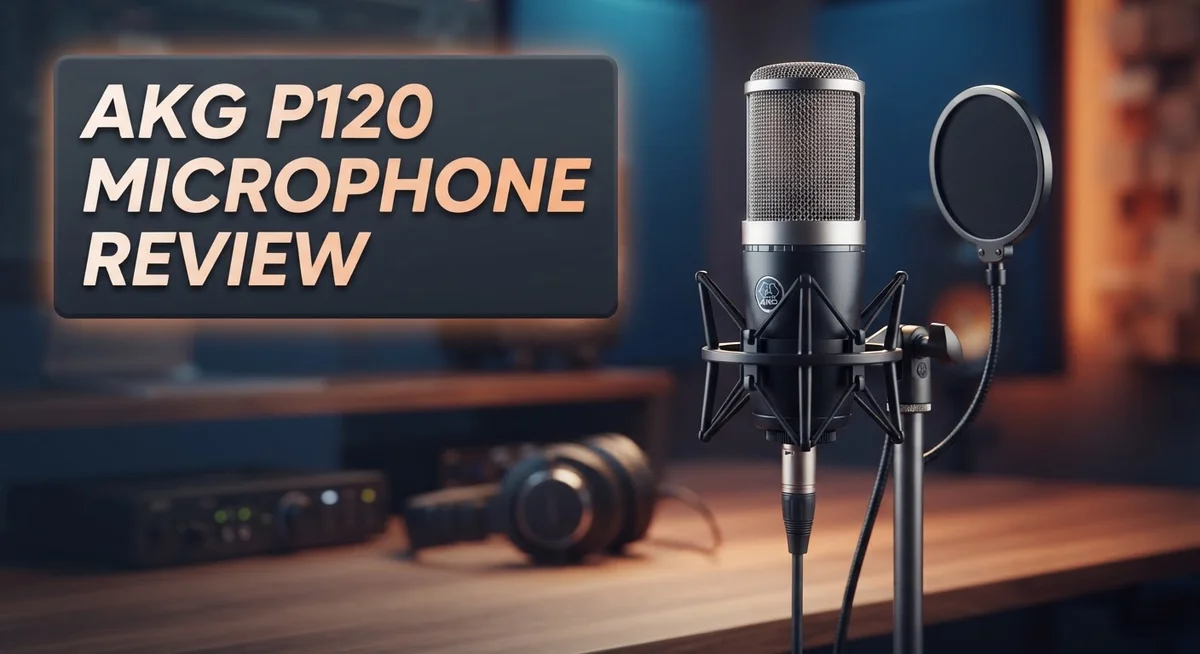
AKG P120 Microphone Review: Worth the Hype?
Looking for a studio condenser mic that fits a small setup? The AKG P120 often comes up in that search. This mic uses a 2/3 inch diaphragm true condenser capsule. That design helps it pick up fine detail in vocals and instruments.
It also handles loud sound sources well. With a max SPL of 150 dB, you can record close to loud amps or drums without distortion.
The build feels solid. Many users report the electronics inside last for years without issues. It includes an attenuation pad too. That feature gives you more control when recording louder sources.
In a Nutshell
- Sound quality stays clear and detailed for vocals, speech, and instruments. It captures accurate tone in most recording setups.
- Build quality feels sturdy. The mic uses durable electronics that can handle regular use without issues.
- Self-noise sits at 19 dB, which is higher than some rivals. You might notice this in very quiet recordings.
- Some users report a muddy low-end on vocals. This mic also lacks extra brightness or presence in its tone.
- A treated room helps this mic perform its best. Without proper acoustic treatment, results can vary.
- It works well with standard audio interfaces, making setup simple for beginners. The included attenuation pad adds flexibility for loud sources.
- Compared to the Audio-Technica AT2020 and Røde NT-1, the P120 holds its own but shows more self-noise.
Specifications and Technical Design
The AKG P120 houses a 2/3 inch diaphragm true condenser capsule. This design captures sound with precision and detail across the frequency spectrum.
The microphone features a low mass diaphragm. This engineering choice allows faster response times to incoming sound waves. You get cleaner transient capture on drums, guitars, and percussion.
Maximum SPL handling reaches 150 dB. This means the P120 can handle loud instruments without distorting. Drums, amplifiers, and brass sections stay clean even at high volumes.
An attenuation pad is built into this microphone. The pad reduces incoming signal strength by a fixed amount. Singers and loud speakers benefit from this feature in small rooms.
Self noise measures at 19 dB. This specification matters for quiet recordings. Higher self noise means more background hiss appears in silent moments. The P120 sits above some competitors in this category. Quieter rooms and careful microphone placement help minimize this effect.
The microphone connects to standard audio interfaces. No special preamps or adapters are required. USB connections are not available on this model. You need an XLR cable and phantom power to operate it.
Frequency response stays relatively flat across the midrange. Vocals and speech reproduction sound natural without heavy coloration. Instruments record with honest character rather than heavy processing.
The capsule design emphasizes accuracy over color. This approach works well for speech, podcasts, and acoustic instruments. Some users notice reduced brightness in the upper frequencies compared to other studio condensers.
Build quality feels solid and durable. Metal construction protects internal components from damage. The microphone withstands regular studio use without issues.
Shock mount compatibility is standard. Most third party shock mounts fit the microphone body. This reduces vibration noise from floor rumble and handling.
The P120 performs best in treated acoustic spaces. Hard walls and reflective surfaces amplify its self noise issues. Foam panels and absorption materials improve recording quality significantly.
This microphone suits home studios and small professional setups. Beginners appreciate the straightforward operation and reliable performance. The technical design prioritizes practical studio use over premium features.

- Versatile Connectivity - Compatible with popular audio interfaces for easy setup, making it ideal for use with popular recording software and hardware. The low-mass diaphragm delivers a clear sound with accurate sonic detail for vocals, speech and instrument recording in project studios and for home recording.
- High SPL Handling - Capable of handling high sound pressure levels up to 150 dB, making it perfect for capturing loud sources without distortion.
Last update on 2026-09-18 / Affiliate links / Images from Amazon Product Advertising API Some of the links on this website are affiliate links, which means that at no additional cost to you, I earn a commission if you click through and make a purchase. I only recommend products and services that I believe will add value to my readers. Thank you for your support!
Sound Quality and Frequency Response
The AKG P120 delivers clear and detailed sound across vocals, speech, and instruments. You get accurate sonic reproduction that works well for home studio recordings. The microphone captures nuance without excessive coloration, which appeals to users who want honest audio capture.
Frequency response on the P120 stays relatively flat through the midrange. This flat profile means the mic doesn’t artificially boost or cut certain frequencies. You hear what you actually record, without the microphone adding unwanted color to your source material.
Low-end performance presents a challenge with this microphone. Some users report a muddy quality when recording vocals. The lower frequencies lack clarity and can sound thick or unclear. This happens especially in untreated rooms where low-end reflections build up. Adding acoustic treatment helps reduce this issue significantly.
The upper midrange and presence peak remain subtle on the P120. This means the microphone lacks brightness compared to some competitors. Vocals may sound slightly duller than expected. Instruments can feel less punchy in the mix. If you prefer presence and air in your recordings, you might find this mic sits back a bit.
The self-noise level of 19 dB affects your recording quality during quiet passages. This sits higher than some rival condensers. You’ll notice more background hiss when recording soft vocals or acoustic instruments. Quieter sources require careful gain staging to minimize this noise floor.
Maximum SPL handling reaches 150 dB. This capability lets you record loud sound sources without distortion. Drums, amplifiers, and percussion stay clean even at high volumes. The included attenuation pad helps further when working with very loud sources.
A treated recording space makes a major difference with this microphone. Hard reflective surfaces worsen the muddy low-end issue. Acoustic panels, bass traps, and soft furnishings improve overall frequency response. The P120 performs noticeably better when your room absorbs excess reflections.
Overall, the P120 captures detail well but shows limitations in low-end clarity and presence. It suits home studios and beginners who can address room acoustics. The sound quality remains solid for spoken word and speech applications where presence peak matters less.
Build Quality and Durability
The AKG P120 comes with a metal body that feels solid in your hands. The construction uses quality materials throughout. You’ll notice the microphone has a professional appearance despite its compact size.
The diaphragm assembly sits at the heart of durability here. AKG uses a low-mass diaphragm design that resists physical stress. This design choice helps the capsule last longer during regular studio use. The internal components are well-protected from accidental bumps and vibrations.
The attenuation pad built into this microphone adds practical durability value. This feature lets you handle louder sound sources without pushing the capsule to its limits. You reduce wear on internal electronics when recording near speakers or instruments playing at high volumes. The pad extends the lifespan of your investment.
Shock mount compatibility is standard on the P120. This means you can easily add external vibration isolation. Proper mounting protects the microphone from handling noise and floor vibrations. Many users pair this mic with aftermarket shock mounts for extra protection.
The electronics inside show solid engineering. Self-noise sits at 19 dB, which reflects the quality of internal components. Higher self-noise sometimes indicates simpler electronics, but the P120 performs consistently over time. Users report that the microphone maintains its sound character after months of regular use.
One thing to note: treated acoustic spaces help preserve the microphone’s longevity. When you use the P120 in a room with proper absorption, you avoid pushing the capsule hard to capture detail. This means less stress on the diaphragm and longer operational life.
The microphone connects securely to standard audio interfaces. This compatibility means no special adapters wear out over time. Your setup stays stable and reliable session after session.
Overall, the P120 demonstrates durability through thoughtful design choices. The metal construction, internal component quality, and built-in attenuation pad all work together. You get a microphone that handles regular studio work without premature wear. This makes it a dependable choice for home studios and small professional spaces.
Top 3 Alternatives
Audio-Technica AT2020

- The price/performance standard in side address studio condenser microphone technology
- Ideal for project/home studio applications
Last update on 2026-09-18 / Affiliate links / Images from Amazon Product Advertising API Some of the links on this website are affiliate links, which means that at no additional cost to you, I earn a commission if you click through and make a purchase. I only recommend products and services that I believe will add value to my readers. Thank you for your support!
The AT2020 stands out as a reliable cardioid condenser microphone for home studios and podcasters. This microphone captures vocals with clarity and detail. It handles acoustic instruments well too.
You’ll appreciate the side-address design. It reduces handling noise during recording sessions. The microphone works with standard mic stands and boom arms. Many users love its consistent performance across different recording environments.
Shure SM7B

- NATURAL VOCALS: Engineered with a dynamic cartridge and wide-range frequency response, the Shure SM7B captures warm, balanced vocals with exceptional clarity, making it ideal for singing, podcasting, voiceover, and professional studio recording
- FOCUSED AUDIO: A precise cardioid pickup pattern works with air suspension shock isolation to minimize background noise, handling vibrations, and room interference, keeping your voice front and center in any recording or streaming environment
Last update on 2026-09-18 / Affiliate links / Images from Amazon Product Advertising API Some of the links on this website are affiliate links, which means that at no additional cost to you, I earn a commission if you click through and make a purchase. I only recommend products and services that I believe will add value to my readers. Thank you for your support!
The SM7B delivers professional-grade sound for serious recording work. This dynamic microphone works beautifully for vocals and instruments alike. It features a built-in presence peak that adds character to your recordings.
The microphone includes a switchable air suspension system. This reduces vibrations from nearby equipment. You get smooth, warm tones without unwanted feedback. The SM7B requires a preamp for optimal performance, which is worth the investment for dedicated studios.
Neumann U87

- Variable large diaphragm microphone
- Classic sound, instantly recognizable yet versatile
Last update on 2026-09-18 / Affiliate links / Images from Amazon Product Advertising API Some of the links on this website are affiliate links, which means that at no additional cost to you, I earn a commission if you click through and make a purchase. I only recommend products and services that I believe will add value to my readers. Thank you for your support!
The U87 represents studio excellence in the condenser microphone category. This microphone has been the industry standard for decades. Recording professionals choose it for vocals, drums, and orchestral work.
It offers switchable cardioid and omnidirectional patterns. This flexibility lets you adapt to different recording situations. The U87 handles high sound pressure levels without distortion. Its presence peak enhances vocal clarity naturally.
Each of these microphones serves different recording needs. The AT2020 works great for beginners building their first setup. The SM7B suits artists wanting dynamic warmth and character. The Neumann U87 appeals to professionals seeking versatility and legendary sound quality. Your choice depends on your studio goals and recording style.
Noise Performance and Self-Noise Levels
The AKG P120 generates self-noise at 19 dB, which sits higher than many competing studio condensers. This noise floor becomes noticeable during quiet vocal passages and ambient recordings. You’ll hear a subtle hiss in the background when you work with soft sources or lower input levels.
Self-noise matters because it limits how quietly you can record. With the P120, you capture clean sound down to a certain threshold. Below that point, the microphone’s internal noise becomes audible. For speech and singing at normal volumes, this rarely causes problems. For delicate acoustic instruments or whisper-close vocals, you may notice the hiss more.
The attenuation pad helps manage this issue somewhat. When you engage the pad, you can push the microphone’s input harder without clipping. This technique lets you record at higher gain levels, which pushes the self-noise further down in your mix. The pad doesn’t eliminate the noise, but it gives you more flexibility in your recording chain.
Compared to alternatives like the Røde NT-1, the P120 carries a higher noise floor. The Røde option delivers lower self-noise specifications, making it better for extremely quiet recording scenarios. The Audio-Technica AT2020 also performs more favorably in noise measurements. If you work primarily with loud sources like drums or guitar amps, this difference becomes negligible.
Your recording environment plays a huge role here. A treated acoustic space masks some of the self-noise through better isolation. Untreated rooms amplify the problem because external noise mixes with the microphone’s internal hiss. Proper room treatment and careful microphone placement help you work around the P120’s noise limitations.
For home studios and small professional setups, the 19 dB self-noise level remains manageable. You’ll achieve clean recordings with typical speaking and singing voices. The microphone works well for podcasts, voiceovers, and standard instrumental recording. Just understand that extremely quiet sources will reveal the noise floor more readily than with premium studio condensers.
Compatibility and Setup
The AKG P120 connects to your setup using a standard XLR connector. This means you can plug it directly into any professional audio interface without adapters. Most modern interfaces accept XLR input, so compatibility stays straightforward.
You’ll need phantom power to operate this microphone. Your audio interface must supply 48 volts of phantom power. Check your interface documentation to confirm this feature exists. Once enabled, the P120 powers on automatically.
The microphone includes a shock mount in the box. This mount reduces vibrations from your desk or stand. Use it to isolate the P120 from physical movement and handling noise. The shock mount connects easily to standard microphone stands.
A pop filter works well with the P120. Position it between your mouth and the microphone to reduce plosive sounds. This simple addition improves vocal recordings significantly. Most pop filters attach to standard mic stands without issues.
Setting up the microphone takes just a few minutes. Mount the shock mount on your stand first. Attach the P120 to the shock mount using the threaded connector. Plug the XLR cable into the microphone and run it to your audio interface. Enable phantom power on your interface before recording.
Gain staging matters for optimal performance. Set your interface input level so peaks reach around 6 dB below clipping. This prevents distortion while capturing enough signal. The P120 works well with moderate gain settings on most interfaces.
The attenuation pad sits on the microphone body itself. This 3 dB pad reduces sensitivity for loud sources. Use it when recording drums, guitar amps, or other high SPL instruments. Simply switch the pad on or off depending on your source.
Cable length affects signal quality. Keep XLR cables under 25 feet when possible. Longer cables can introduce noise, though quality cables minimize this issue. Use balanced XLR cables exclusively with this microphone.
Your recording software recognizes the P120 automatically. No drivers are needed. Select your audio interface as the input device in your DAW settings. The microphone appears as an available input channel immediately.
Pros and Cons
Pros
- Captures vocal and instrument detail with solid accuracy across most frequency ranges
- Solidly built metal body with low-mass diaphragm design that resists damage
- Includes an attenuation pad to manage loud sound sources without distortion
- Works seamlessly with standard audio interfaces and XLR connections
- Shock mount included in the box for quick setup
Cons
- Self-noise level at 19 dB sits higher than competing studio condensers, limiting quiet recording sessions
- Low-end response sounds muddy on vocals, requiring extra EQ work in post-production
- Lacks brightness and presence in the upper midrange, making some sources sound dull
- Performs best in acoustically treated rooms; untreated spaces reveal noise floor issues
Who Should Buy It
The AKG P120 works best for specific recording situations and user types. Let’s break down who gets real value from this microphone.
Home studio owners benefit most from the P120. You’re recording in a treated room where you control the acoustic environment. The 19 dB self-noise level becomes less problematic when your room is quiet. You can capture vocals and spoken word content with solid accuracy. The microphone’s solid build means it survives years of regular use without failing.
Content creators and podcasters find the P120 practical for their work. You need a microphone that connects easily to your audio interface. The XLR connector and phantom power setup take minutes to configure. The shock mount arrives in the box, so you start recording quickly. Speech clarity remains good, though you may need slight EQ adjustments in post-production.
Musicians recording acoustic instruments see decent results with the P120. The microphone captures instrument detail across most frequency ranges. Guitarists, acoustic performers, and instrument enthusiasts appreciate the accurate sonic reproduction. The attenuation pad helps when recording louder instruments without distortion.
Budget-conscious professionals represent another key audience. You want a true condenser microphone without spending excessively. The P120 delivers studio-quality construction and performance for this group. You’re willing to work around the muddy low-end through careful mic placement and EQ.
However, the P120 isn’t ideal for everyone. If you record in untreated or noisy rooms, the higher self-noise becomes frustrating. You’ll hear background hum and ambient noise in quiet passages. Professional studios with strict noise requirements should consider alternatives. If you need brightness and presence in your recordings, the P120’s duller character requires significant post-production work.
The microphone suits you if you prioritize reliability, ease of use, and accurate vocal or speech capture. You accept that some frequency ranges need EQ adjustment. You work in reasonably quiet spaces. Your recording needs fall within home or small professional studio ranges. The P120 becomes a practical choice when these conditions match your situation.
Final Verdict
The AKG P120 stands out as a solid choice for anyone starting a home studio. Its build quality feels sturdy, and it delivers clear vocal capture for most everyday recording needs.
This microphone shines in specific situations. Podcasters, YouTubers, and voiceover artists get reliable results without much fuss. Musicians tracking acoustic guitars or simple vocal parts also find good value here.
However, this mic has real limits. The higher self-noise level means quiet passages can pick up unwanted hiss. Singers wanting crisp, airy vocals might feel disappointed by the muddy low-end and lack of top-end sparkle.
Compared to the Audio-Technica AT2020, the P120 offers similar build quality but falls short on clarity. The AT2020 tends to sound brighter and more balanced across genres.
The Røde NT-1 pulls ahead in noise performance. Its self-noise sits lower, making it a better pick for whisper-quiet recordings or classical music capture.
Still, the P120 holds its own for casual and semi-professional use. If you’re recording podcasts, streaming, or basic music demos, this mic gets the job done without complications.
Your room treatment matters a lot here. Without proper acoustic treatment, the P120’s weaknesses become more noticeable. Pair it with foam panels or a vocal booth for best results.
Who should buy this mic? Beginners entering home recording will appreciate its simplicity. Content creators who need dependable audio without deep technical knowledge will also benefit.
Who should skip it? Professional vocalists seeking studio-grade clarity might want to look elsewhere. Anyone recording in untreated rooms may struggle with added noise issues too.
Overall, the AKG P120 fits a specific niche well. It works best as an entry point into condenser microphones rather than a long-term professional tool. Think of it as a stepping stone toward better gear down the line.
For casual creators and hobbyists, this mic delivers dependable performance. Just keep your expectations realistic based on its known limitations.
Frequently Asked Questions
Does the AKG P120 work with my audio interface?
Yes, the P120 connects to any standard audio interface using an XLR cable. You’ll plug the microphone into a standard XLR input on your interface. The shock mount included in the box attaches easily to your mic stand. No special adapters or unusual equipment is needed.
Why does the P120 sound muddy on vocals?
The P120 has a heavy low-end response that can make voices sound thick and unclear. This happens because the diaphragm design boosts bass frequencies naturally. You can fix this in post-production by using an EQ plugin to cut low frequencies around 100-200 Hz. A treated recording room also helps reduce mud by controlling reflections.
Is 19 dB self-noise a problem for me?
Self-noise matters most if you record very quiet sources or silent passages. The 19 dB level means you’ll hear a subtle hiss during quiet moments. This becomes noticeable when you boost gain during editing. For podcasts, streaming, and normal speech recording, most users don’t find it bothersome. If you record soft acoustic instruments or ASMR content, you might want a quieter microphone.
How does the P120 compare to the Audio-Technica AT2020?
Both microphones have solid metal construction and work well for beginners. The AT2020 offers clearer, brighter sound with lower self-noise. The P120 captures vocals accurately but lacks that presence peak. Choose the P120 if you prefer warm, detailed recordings. Pick the AT2020 if you want crisp clarity and less background hiss.
What recording situations suit the P120 best?
The P120 excels for podcasting, streaming, and spoken word content. It captures speech with good intelligibility. Acoustic guitar and piano recordings sound decent too. The microphone shines when your room has basic treatment like foam panels or blankets. Avoid using it for recording very quiet instruments or in untreated, reflective spaces.

Hello, I’m Juniper Harkness, a tech enthusiast and the creator of TechReviewz.blog, where I dive deep into the latest technology products available on Amazon.