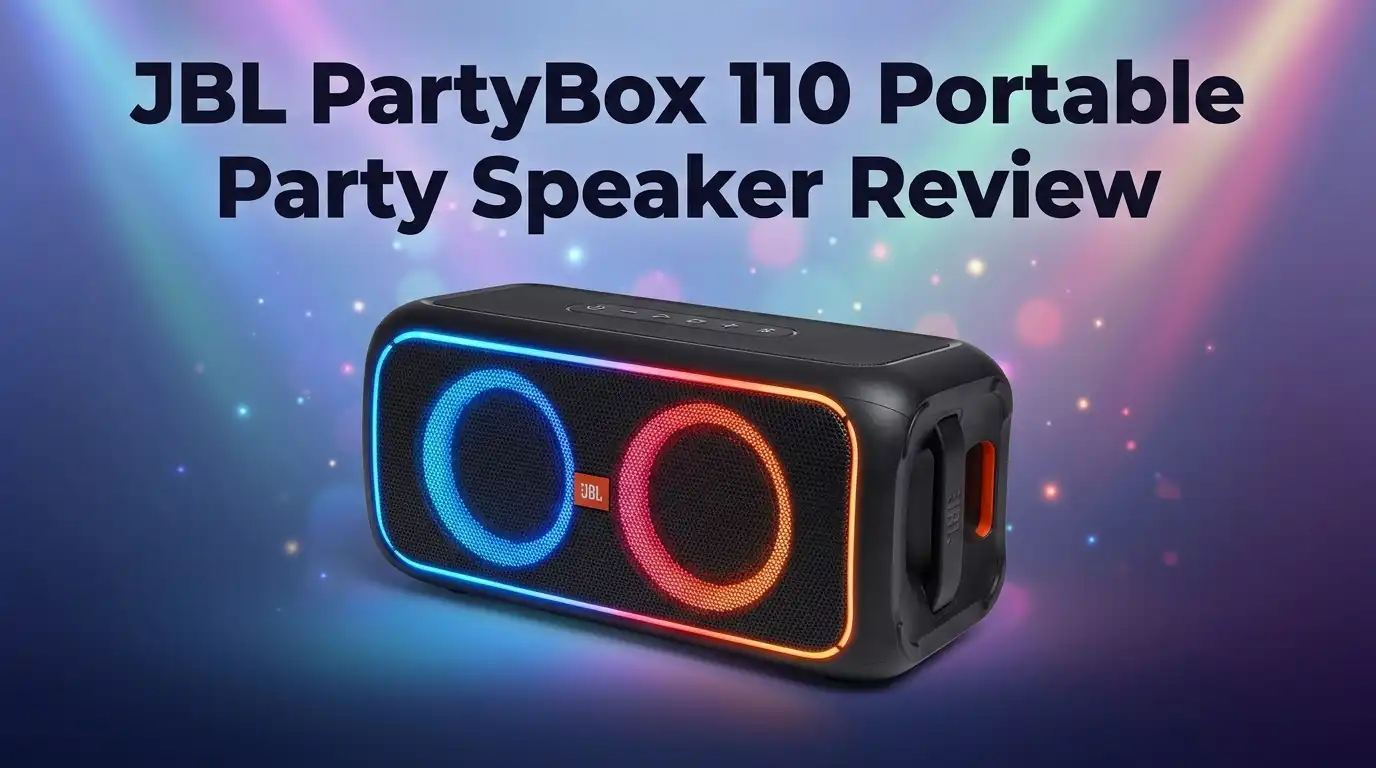
JBL PartyBox 110 Portable Party Speaker Review 2026
The JBL PartyBox 110 has been the default answer for “loud speaker with lights” since 2021. Five years later, people still buy it every weekend.
That fact alone raises a question. Does a 2021 speaker still deserve your money in 2026?
I spent weeks testing this speaker at backyard cookouts, in a garage, and in a small rented hall. I played hip hop, rock, reggaeton, and podcasts through it.
In a Nutshell:
- Sound is the strongest feature. The PartyBox 110 pushes 160W RMS through two 5.25 inch woofers and two 2.25 inch tweeters. Vocals stay clear at high volume, and the bass hits hard without turning muddy.
- Battery life lands near 10 hours in real use. JBL advertises 12 hours. At loud volume with lights running, expect 6 to 8 hours instead. Charging takes roughly 3.5 hours.
- The light show still impresses guests. Two ring lights, two tweeter halos, and two strobes sync to the beat. You can control every element from the free JBL PartyBox app.
- Portability has limits. The speaker weighs 23 pounds and stands 22.4 inches tall. Two handles help, but this is not a speaker you carry one handed across a park.
- It is not fully waterproof. The IPX4 rating covers splashes only. Rain and pool spray are fine, submersion is not.
- Price has dropped. Original list price sat near $379. In 2026 you often find it between $250 and $300, which changes the value story completely.
What Is the JBL PartyBox 110?

- POWERFUL JBL ORIGINAL PRO SOUND: Whether you're at home or outdoors, the JBL PartyBox 110 makes your music amazing with two levels of deep, adjustable bass and 160W powerful JBL Signature Sound.
- 12 HOURS OF PLAYTIME AND PORTABLE DESIGN: Power the party all day or all night. With 12 hours of playtime and a built-in rechargeable battery, the beat will go on (and on)
Last update on 2026-08-18 / Affiliate links / Images from Amazon Product Advertising API Some of the links on this website are affiliate links, which means that at no additional cost to you, I earn a commission if you click through and make a purchase. I only recommend products and services that I believe will add value to my readers. Thank you for your support!
The JBL PartyBox 110 is a battery powered party speaker with built in RGB lighting. JBL released it as an upgrade to the older PartyBox 100.
It sits in the middle of the PartyBox family. The Encore Essential sits below it. The PartyBox 310 and Stage 320 sit above it.
The speaker measures 22.4 inches tall, 15.3 inches wide, and 15.6 inches deep. It weighs 23 pounds with the battery inside.
Inside the cabinet you get two 5.25 inch woofers and two 2.25 inch tweeters. JBL rates the frequency response at 45 Hz to 20 kHz.
Power output is 160W RMS. That number matters because many rival brands quote peak power, which inflates the figure.
You connect through Bluetooth 5.1, a 3.5mm aux input, or a USB stick loaded with MP3, WAV, or WMA files. Only one source plays at a time.
Two 1/4 inch inputs on the back accept a microphone and a guitar. Each input has its own volume knob.
The design intent is simple. JBL built a speaker that survives a patio party, plays loud enough for 40 people, and looks fun while doing it.
It also mounts on a standard PA speaker pole. A plastic cap on the base hides the mounting socket.
Unboxing the JBL PartyBox 110
The box arrives large and heavy. Mine showed up in a plain brown shipper with the retail box inside.
Cardboard inserts hold the speaker firmly. JBL wraps the unit in a thin fabric bag, which feels nicer than the plastic sheeting many brands use.
Lifting the speaker out takes two hands. The two moulded handles on the sides make this easy once you find them.
Inside the box you get the speaker, a figure 8 AC power cable, a quick start guide, a safety sheet, and a warranty card.
That is the full list. JBL includes no microphone, no aux cable, no carry strap, and no dust cover.
The missing microphone surprises people who buy this for karaoke. You must supply your own wired mic with a 1/4 inch plug.
First impressions are strong. The metal grille feels solid, the orange rubber feet look sharp, and the top panel controls click with confidence.
Peeling the protective film off the top panel is oddly satisfying. The glossy control surface underneath looks premium at first, then collects fingerprints within an hour.
Setup takes under two minutes. Plug in the cable, press power, and the speaker enters pairing mode automatically with a chime.
My phone found it instantly. The first firmware update through the app took another five minutes.
Design and Build Quality
The PartyBox 110 feels overbuilt in a good way. The plastic shell resists flex when you squeeze it.
A metal grille protects the drivers and the lights. It handled a knocked over folding chair without a dent.
Placement options are flexible. Four rubber pads on the bottom support vertical use, and stiff rubber feet on the side support horizontal use.
Horizontal placement changes the light pattern orientation but the sound stays balanced. I used it flat on a shelf for background music.
The back panel hides behind a rubber flap. That flap seals the aux input, USB port, mic input, guitar input, TWS button, and power socket.
Pulling the flap back feels stiff at first. It loosens after a few weeks, which is normal for rubber gaskets.
The top panel holds a volume dial, a play button, a bass boost button, a light button, and the power button. An LED strip shows battery level in four segments.
The volume dial is the highlight. It turns smoothly and gives precise control, unlike the plus and minus buttons on cheaper speakers.
Two complaints stand out. The glossy top panel scratches easily, and the four segment battery meter tells you very little.
You will rely on the app for an accurate battery percentage. That feels like an odd omission on hardware this expensive.
Top 3 Alternative for JBL PartyBox 110

- Powerful JBL Pro Sound: Rock out to powerful JBL Pro Sound that delivers clear, dynamic sounds and deeper bass even at top volume.
- Futuristic lightshow: Pair that amazing sound with a thrilling futuristic lightshow featuring starry lights, cool light trails, and strobe light effects, all synced to your beat.
Last update on 2026-08-18 / Affiliate links / Images from Amazon Product Advertising API Some of the links on this website are affiliate links, which means that at no additional cost to you, I earn a commission if you click through and make a purchase. I only recommend products and services that I believe will add value to my readers. Thank you for your support!
JBL PartyBox Club 120

- POWERFUL SOUND: Experience the power of a bluetooth speaker loud enough to bring your favorite songs to life with the Sony ULT Field 7 Wireless Portable Bluetooth Karaoke Party Speaker. This loud speaker features a unique X-Balanced Speaker Unit that ensures a deep, clear bass sound, perfect for parties or solitary listening.
- CONNECTIVITY: This bluetooth speaker offers the convenience of wireless connectivity with Bluetooth Fast Pair and multipoint connection features. Ideal as outdoor bluetooth speakers, they allow you to connect multiple devices at once and switch seamlessly between your phone, tablet, or laptop.

Last update on 2026-06-09 / Affiliate links / Images from Amazon Product Advertising API Some of the links on this website are affiliate links, which means that at no additional cost to you, I earn a commission if you click through and make a purchase. I only recommend products and services that I believe will add value to my readers. Thank you for your support!
Sony ULT Field 7

- Nothing beats amazing JBL Original Pro Sound with deep bass.
- The dynamic light show delivers with fun ring light and a cool strobe effect that syncs to the beat of your music.
Last update on 2026-08-18 / Affiliate links / Images from Amazon Product Advertising API Some of the links on this website are affiliate links, which means that at no additional cost to you, I earn a commission if you click through and make a purchase. I only recommend products and services that I believe will add value to my readers. Thank you for your support!
JBL PartyBox Encore Essential
Sound Quality in Real Testing
The PartyBox 110 sounds like a small PA system, not a boombox. That difference shows up immediately.
Vocals sit forward in the mix. Podcast voices and rap vocals stay intelligible even at 80 percent volume.
Midrange handling is the quiet strength here. Guitars, pianos, and snare drums each hold their own space instead of blurring together.
Treble is crisp without harshness. Cymbals shimmer rather than hiss, which many rival party speakers get wrong.
Bass reaches down to about 45 Hz. Kick drums land with real weight, though the deepest sub bass notes in trap and dubstep fade away.
I tested house, classic rock, country, reggaeton, and 90s alternative. Every genre came through evenly, with no genre falling apart.
The speaker gets genuinely loud. In an open backyard it filled a space of roughly 40 feet across with volume to spare.
Indoors, 50 percent volume is already too loud for conversation. Most home users will never pass 60 percent.
Distortion stays controlled until you reach maximum volume. At 100 percent with bass boost high, the low end starts to compress and lose definition.
The honest summary is this. The PartyBox 110 delivers about 90 percent of the sound quality that a casual listener can perceive, and the missing 10 percent only shows up in critical listening.
Bass Boost and Volume Behaviour
The bass boost button cycles through three states. Off, level one, and level two.
Level one adds warmth without bloat. I left it here for most listening sessions.
Level two adds thump you feel in your chest. It works well on electronic and hip hop tracks made for heavy low end.
Level two hurts acoustic music. Guitars sound thick and vocals lose some clarity.
There is no equaliser in the app. That absence frustrates anyone who wants to tune the treble or scoop the mids.
JBL added full EQ control to newer PartyBox models. The 110 never received that feature through firmware.
Volume scaling is well judged. The dial gives fine control at low levels and larger jumps near the top.
One quirk deserves mention. The speaker limits bass output when the battery drops below roughly 20 percent, which protects the amplifier.
You will notice the change if you are listening closely. Most people at a party will not.
Rear ports push air out the back. Place the speaker at least six inches from a wall or the bass turns boomy.
I measured a clear improvement in bass tightness simply by moving the unit forward on a table. Position matters more than most reviews admit.
The Light Show and Party Effects
Lights are half the reason people buy a PartyBox. JBL knows this well.
The 110 uses three separate lighting zones. A figure 8 ring around the woofers, two small halos around the tweeters, and two strobes at the ends.
All lights sync to the beat. The detection works well on music with a clear kick drum and less well on ambient tracks.
Five preset patterns cover spinning, flashing, flowing, and colour morphing effects. You cycle through them with the top panel button.
The app opens more control. You can switch off any zone, lock the lights to a single static colour, or trigger nine freestyle effects manually.
Turning off the strobes is a useful option. Strobes look exciting for ten minutes and become tiring after an hour.
Static white light works nicely for indoor use. It turns the speaker into a soft accent lamp rather than a nightclub fixture.
The app also holds nine DJ sound effects. Vinyl scratches, applause, boos, and an air horn all sit one tap away.
These effects feel gimmicky. My friends used them constantly for one evening and never again.
Lights cost battery. Running the full show at high brightness cuts roughly two hours from your playtime.
Battery Life and Charging Reality
JBL claims 12 hours of playback. That claim is technically true and practically misleading.
The 12 hour figure assumes low volume with the lights switched off. Nobody buys a party speaker to use it that way.
Here are the numbers I recorded. At 50 percent volume with lights on, I averaged 9 hours 40 minutes.
At 65 percent volume with lights on and bass boost at level one, I got 5 hours 50 minutes.
At 80 percent volume with the full light show, playback stopped at 4 hours 15 minutes.
The internal battery holds 36Wh. Charging from empty takes about 3.5 hours from a wall socket.
You cannot swap the battery. Newer JBL models such as the Club 120 offer a replaceable battery, and the 110 does not.
That matters for long term ownership. Lithium cells degrade after three or four years of regular use.
The speaker plays while charging, so an extension cord solves any long event. Battery health also stays better when you avoid full discharges.
One useful detail is missing. The PartyBox 110 has no USB power bank function, so you cannot charge your phone from it.
Bluetooth, App Control, and Stereo Pairing
Bluetooth 5.1 handles the wireless connection. Range held steady at roughly 30 feet indoors through one wall.
Pairing is quick and the speaker remembers previous devices. Switching from my laptop to my phone took one tap.
Latency is the weak point. Video and Bluetooth do not match well, so lip sync drifts noticeably during films.
Use the 3.5mm aux input for video or DJ work. Latency disappears completely on a wired connection.
The JBL PartyBox app is free on iOS and Android. It handles lights, TWS mode, karaoke settings, DJ effects, battery percentage, and firmware updates.
True Wireless Stereo pairs two PartyBox 110 units. Press the TWS button on each speaker and they link within seconds.
Two units in stereo sound outstanding. The soundstage widens dramatically and the volume ceiling rises well beyond one speaker.
Through the app you can switch both speakers to play the full mix instead of split channels. That option helps when you place them in opposite corners.
Controls on either speaker adjust both units. Only the power button stays independent.
One limitation frustrates owners. The PartyBox 110 does not connect to newer PartyBox models over Auracast, so mixing generations does not work.
Karaoke, Microphone, and Guitar Inputs
Two 1/4 inch inputs sit on the back panel. One is labelled Mic and one is labelled Guitar.
Each has an independent volume knob. You can run two microphones at once by using both inputs.
The mic input applies echo by default. It sounds more like light reverb, and it flatters average singers.
The app adjusts the echo level, plus bass and treble on the vocal channel. You can switch echo off entirely for speeches.
The guitar input adds no effects. Plug in an electric guitar and you get a clean, flat signal.
Karaoke performance is good, not professional. Vocals cut through the music clearly and feedback stays manageable at sensible volumes.
There is no dedicated vocal ducking. The music does not dip automatically when someone sings, so you must lower the music yourself.
No microphone comes in the box. Budget an extra $20 to $40 for a decent wired dynamic mic.
Wireless microphone systems work if you connect the receiver to the mic input. Bluetooth microphones do not pair directly.
Small venues and school events suit this setup well. Weddings and larger halls need a proper PA system instead.
What the JBL PartyBox 110 Does Not Do Well
Every review should list the failures honestly. Here are the ones that matter.
No equaliser. You get three bass presets and nothing else. Anyone who wants treble control will feel restricted.
No replaceable battery. When the cell degrades, you replace the whole speaker or pay for a service repair.
No Auracast support. The 110 only pairs with another 110, which limits future expansion.
The 23 pound weight is real. Carrying it up two flights of stairs is a workout, and there is no shoulder strap option.
IPX4 only. Splash resistance protects against rain and drink spills. Do not leave it out in a storm and never drop it in a pool.
Bluetooth latency ruins video. Watching films or gaming through Bluetooth produces visible lip sync delay.
The glossy control panel scratches. Mine picked up fine marks within a month of normal handling.
No power bank feature. Rival speakers at this price charge your phone, and this one does not.
Sub bass rolls off at 45 Hz. Bass heavy electronic genres lose their deepest layer.
The speaker also lacks any voice assistant support. That absence bothers almost nobody, but it is worth stating.
None of these flaws break the product. Together they explain why newer models exist.
Pros and Cons
Here is the balanced summary in list form.
Pros
- Excellent sound for the price. 160W RMS delivers clear vocals, controlled bass, and crisp treble across every genre.
- Beat synced light show. Three lighting zones with five patterns create real party atmosphere, with full app control.
- Strong build quality. Metal grille, thick plastic shell, and rubber feet handle rough handling well.
- Flexible placement. Stands vertically, lies horizontally, or mounts on a standard PA pole.
- Two instrument inputs. Microphone and guitar inputs with individual volume knobs enable karaoke and live practice.
- True Wireless Stereo. Pairing two units creates a genuinely impressive stereo setup.
- Falling price. Frequent discounts now place it well below its original launch price.
Cons
- Heavy at 23 pounds. Transporting it alone becomes tiring over any real distance.
- No equaliser. Three bass presets are the only tone control available.
- Battery is not user replaceable. Long term ownership depends on cell health you cannot fix.
- IPX4 rating only. Splash proof does not mean waterproof, so pool accidents end badly.
- No microphone included. Karaoke buyers face an extra purchase.
- Bluetooth latency. Video and gaming require the aux cable instead.
- Older platform. No Auracast and no newer JBL feature updates.
JBL PartyBox 110 vs the 2026 Competition
The market changed since 2021. Several strong rivals now compete directly.
The JBL PartyBox Club 120 is the natural successor. It offers a replaceable battery, Auracast support, an equaliser, and a foldable handle.
Sound quality between the two is close. The Club 120 wins on features, and the 110 often wins on price.
The Sony ULT Field 7 takes a different approach. It delivers 30 hours of battery, an IP67 waterproof rating, and a shoulder strap.
Sony emphasises portability and durability. JBL emphasises raw output and stage presence.
If you take the speaker to beaches and pools, the Sony makes more sense. If you host garden parties, the JBL sounds bigger.
The JBL PartyBox Encore Essential costs less and weighs only 13 pounds. It produces 100W and includes a wireless microphone in some bundles.
Step up instead and the JBL PartyBox 310 brings 240W, 18 hours of battery, and telescopic wheels.
The 310 suits people who need volume for 80 guests. The wheels also solve the weight problem entirely.
Against all of these, the PartyBox 110 holds one clear advantage. Its price per watt is now the best in the JBL lineup.
Who Should Buy the JBL PartyBox 110?
- POWERFUL JBL ORIGINAL PRO SOUND: Whether you're at home or outdoors, the JBL PartyBox 110 makes your music amazing with two levels of deep, adjustable bass and 160W powerful JBL Signature Sound.
- 12 HOURS OF PLAYTIME AND PORTABLE DESIGN: Power the party all day or all night. With 12 hours of playtime and a built-in rechargeable battery, the beat will go on (and on)
Last update on 2026-08-18 / Affiliate links / Images from Amazon Product Advertising API Some of the links on this website are affiliate links, which means that at no additional cost to you, I earn a commission if you click through and make a purchase. I only recommend products and services that I believe will add value to my readers. Thank you for your support!
Buy this speaker if you host parties at home for 20 to 50 people. It fills that space with clean, loud sound.
Buy it if you want lights that react to music. Few speakers under $300 match this light show.
Buy it if you sing karaoke occasionally. The mic input with echo covers casual sessions well.
Buy it if you play in a small acoustic duo. Two 1/4 inch inputs and PA pole mounting handle coffee shop gigs.
Skip it if you travel light. At 23 pounds with no strap, this is a car speaker rather than a backpack speaker.
Skip it if you need waterproofing. IPX4 protects against splashes and nothing more.
Skip it if you want a future proof platform. The Club 120 offers Auracast and a swappable battery for a modest premium.
Skip it if you plan to watch films through Bluetooth. Latency will annoy you within minutes.
Value depends heavily on price. At $250 to $300 this speaker is a strong buy in 2026.
At full list price the newer models make more sense. Watch for sales and act when the discount appears.
Final Verdict
The JBL PartyBox 110 remains a good speaker in 2026. Age has cost it features, not sound quality.
Its audio still competes with speakers released four years later. That says something about the original engineering.
The flaws are real and worth accepting at the right price. No equaliser, a sealed battery, and modest water protection all limit it.
The strengths are equally real. Loud clean output, a proper light show, dual instrument inputs, and stereo pairing add up to genuine party value.
I rate it 4.3 out of 5 for casual party use. That drops to 3.8 out of 5 if you need portability or waterproofing.
Buy it on discount and you will not regret the purchase. Buy it at launch price and the newer PartyBox Club 120 is the smarter choice.
Frequently Asked Questions
Is the JBL PartyBox 110 waterproof?
No. It carries an IPX4 rating, which protects against splashes and light rain from any direction. Submersion, heavy jets, and pool drops will damage it permanently.
How long does the JBL PartyBox 110 battery last?
JBL claims 12 hours. Real world use at 50 percent volume with lights on delivers close to 10 hours. Loud volume with the full light show drops that figure to roughly 4 to 6 hours.
Does the JBL PartyBox 110 come with a microphone?
No microphone is included. You need a wired microphone with a 1/4 inch plug, which typically costs $20 to $40.
Can you connect two JBL PartyBox 110 speakers together?
Yes. Press the TWS button on each speaker and they pair as a stereo set within seconds. The app lets you switch between stereo mode and dual mono mode.
Is the JBL PartyBox 110 loud enough for outdoor parties?
Yes for medium gatherings. It comfortably covers a backyard with 40 to 50 people. Larger outdoor events need the PartyBox 310 or two units paired together.
Can the JBL PartyBox 110 battery be replaced?
Not by the user. The battery sits inside the sealed chassis and requires service centre replacement, unlike the newer PartyBox Club 120.
Does the JBL PartyBox 110 have an equaliser?
No. You get three bass boost settings only. The app does not include a graphic or parametric equaliser.
Is the JBL PartyBox 110 still worth buying in 2026?
Yes, if you find it discounted below $300. Sound quality holds up well, but buyers who want Auracast, a replaceable battery, or an equaliser should choose a newer model.

Hello, I’m Juniper Harkness, a tech enthusiast and the creator of TechReviewz.blog, where I dive deep into the latest technology products available on Amazon.